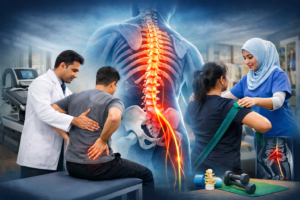
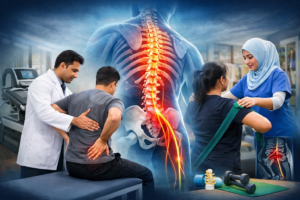
Sciatica has become a significant musculoskeletal and neurological health concern in Bangladesh, particularly among adults engaged in prolonged sitting or physically demanding work. Although commonly described as back pain, sciatica is far more complex, involving irritation of the sciatic nerve that can severely affect mobility, work capacity, and overall quality of life.
In Bangladesh, it is common for sciatica patients to rely heavily on pain medication, injections, or extended rest periods. In some cases, surgical intervention is suggested early, even before structured conservative care is attempted. However, contemporary clinical evidence supports that the majority of sciatica cases can be effectively managed without surgery when treated through a systematic, non-surgical approach.
A leading example of this approach can be seen at ASPC Manipulation Therapy Centre, where sciatica management is guided by advanced clinical reasoning rather than routine protocols. Under the clinical direction of Dr. Mohammad Shahadat Hossain and the rehabilitation expertise of Dr. Sapia Akter, patients receive structured, non-surgical care focused on restoring function and preventing recurrence.
Rethinking Sciatica Beyond the Need for Surgery
Sciatica is not a diagnosis on its own but a descriptive term for symptoms arising from irritation or compression of the sciatic nerve or its lumbar nerve roots. The sciatic nerve originates in the lower spine and extends through the pelvis and down the legs, which explains why pain often travels from the back into the lower limb.
A key challenge in sciatica management is that symptom severity does not always align with imaging findings. This mismatch highlights why surgery should not be considered the first line of treatment. Effective non-surgical treatment emphasizes understanding nerve behavior, spinal loading, and movement dysfunction rather than treating MRI reports alone.
Lifestyle Factors
Long hours of sitting, inadequate ergonomic awareness, and heavy lifting in the Bangladeshi context place excessive stress on the lumbar spine.
Root Cause Focus
Unlike medication which suppresses symptoms, conservative management aims to resolve the mechanical root cause of nerve irritation.
Precise Assessment
In-depth evaluation of neurological function, spinal mobility, posture, and muscle performance is essential for recovery.
The Foundation of Effective Treatment
Successful non-surgical care begins with precise clinical assessment. At ASPC Manipulation Therapy Centre, each patient undergoes an evaluation that examines symptom behavior, neurological function, and functional tasks. Imaging findings are reviewed when necessary but interpreted within a broader clinical context.
SDM: Spinal Decompression Method
A key component of treatment at ASPC is the Spinal Decompression Method (SDM). SDM is a carefully controlled technique designed to reduce excessive pressure on spinal discs and nerve roots. By lowering disc pressure and enhancing hydration, SDM helps relieve mechanical stress and supports the body’s natural healing processes.
“Reducing pain is only the first step. Long-term success depends on rebuilding strength, improving movement quality, and restoring confidence through individualized rehabilitation.”
Rehabilitation: The Bridge to Recovery
Phase-wise care led by Dr. Sapia Akter, PT focuses on core stability, hip control, and functional capacity. Her approach places strong emphasis on patient education, helping individuals understand how to protect their spine during daily activities, with special attention given to elderly patients and women.
Phase 1: Stabilization
Education, posture correction, and activity modification to reduce acute nerve irritation.
Phase 2: Mobilization
SDM and manual therapy techniques to improve spinal mobility and restore normal nerve movement.
Phase 3: Strengthening
Core strengthening and correcting faulty movement patterns to prevent future recurrence.
Patient Satisfaction and Outcomes
Patients frequently describe the care at ASPC as gentle yet impactful. Reduced reliance on pain medication, improved mobility, and renewed confidence in daily activities are commonly shared outcomes. Importantly, patients feel actively involved in decision-making, which enhances long-term adherence.
Final Thoughts
Sciatica does not inevitably require surgical intervention. In Bangladesh, a well-structured non-surgical approach provides a safe, effective, and evidence-based solution for the majority of patients. Reclaim an active and healthier life without surgery through expert clinical reasoning and patient-centered care.
ASPC Manipulation Therapy Centre
Expert Care by Dr. Mohammad Shahadat Hossain & Dr. Sapia Akter