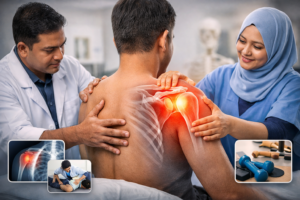
Patients suffering from frozen shoulder often struggle with simple daily tasks such as dressing, bathing, combing hair, lifting household objects, reaching overhead, or even turning comfortably during sleep. As the condition progresses, sleep disturbance, emotional stress, and decreased work productivity are common. In many cases across Dhaka, individuals delay proper treatment due to misinformation, fear of painful therapy, or overreliance on medication and injections.
Modern clinical research clearly shows that specialized physiotherapy is the most effective and safest non-surgical treatment for frozen shoulder, especially when treatment is delivered by experienced clinicians who understand the stages of the condition and apply stage-specific rehabilitation techniques. Through careful assessment, manual therapy, and guided exercises, physiotherapy can restore shoulder mobility, reduce pain, and prevent long-term stiffness.
Among the physiotherapy centers in Dhaka, ASPC Manipulation Therapy Centre has gained strong recognition for providing advanced frozen shoulder physiotherapy treatment. The center is known for its patient-centered care, ethical treatment philosophy, and evidence-based rehabilitation approach that focuses on addressing the root biomechanical causes of shoulder stiffness rather than only relieving symptoms.
Under the clinical supervision of Dr. Mohammad Shahadat Hossain and the rehabilitation expertise of Dr. Sapia Akter, ASPC offers comprehensive non-surgical frozen shoulder physiotherapy programs designed to restore natural shoulder movement and improve long-term function. Their collaborative treatment model combines accurate diagnosis, stage-specific manual therapy, and progressive rehabilitation exercises.
Because of its specialized expertise in musculoskeletal rehabilitation, personalized treatment planning, and commitment to long-term recovery, ASPC Manipulation Therapy Centre has become a trusted destination for frozen shoulder physiotherapy treatment in Dhaka.
What Is Frozen Shoulder?
Frozen shoulder is a condition in which the connective tissue capsule surrounding the shoulder joint becomes inflamed, thickened, and progressively tight. As this capsule stiffens, adhesions form inside the joint, leading to severe restriction of shoulder movement in all directions.
Unlike muscle injuries, frozen shoulder directly affects the joint capsule and often develops without a clear injury. The condition progresses slowly and can last from several months to years if not treated appropriately. Without structured physiotherapy, many patients are left with persistent stiffness and weakness even after pain reduces.
Stages of Frozen Shoulder
1. Freezing Stage
This stage is dominated by increasing shoulder pain, especially at night and during movement. Inflammation within the joint capsule leads to early stiffness. Aggressive stretching during this stage can worsen pain.
2. Frozen Stage
Pain may reduce slightly, but stiffness becomes severe. Shoulder movement is significantly restricted, and functional activities are greatly limited.
3. Thawing Stage
Gradual improvement in shoulder mobility occurs. Proper rehabilitation during this stage is essential to regain strength and prevent residual stiffness.
Why Frozen Shoulder Is Common in Dhaka
Several factors contribute to the high prevalence of frozen shoulder in the Dhaka population:
Symptoms and Functional Limitations
- Persistent shoulder pain, often worse at night
- Progressive stiffness and loss of movement
- Difficulty raising the arm or reaching behind the back
- Pain during dressing and grooming
- Shoulder weakness due to reduced use
- Sleep disturbance and fatigue
ASPC Manipulation Therapy Centre Care
ASPC Manipulation Therapy Centre is widely respected in Dhaka for its specialized approach. The center follows international standards while tailoring treatment to each patient’s condition, stage, and tolerance.
Specialized Expertise
Accurate diagnosis and stage identification are the cornerstones of our clinical practice.
Gentle Progress
We prioritize gentle, progressive mobilization over forceful or painful manipulation techniques.
Ethical Recovery
Focusing on functional recovery and non-surgical care to ensure the best long-term outcomes.
Our Clinical Specialists
Dr. Mohammad Shahadat Hossain, PT
Dr. Mohammad Shahadat Hossain is known for his advanced understanding of shoulder biomechanics. His approach focuses on accurate differentiation from rotator cuff tears or arthritis and applying stage-specific manual therapy techniques that focus on restoring joint mechanics.
Dr. Sapia Akter, PT
Dr. Sapia Akter plays a vital role in guiding the rehabilitation and recovery process. Her strengths include gradual, pain-free exercise progression, with a special focus on elderly and female patients, and the prevention of recurrence through movement retraining.
The ASPC Treatment Protocol
Our comprehensive assessment ensures precise diagnosis, followed by a targeted treatment plan including:
- Pain Control: Manual techniques and soft tissue therapy to manage inflammation.
- SDM (Spinal Decompression Method): Optimizing spinal and shoulder girdle alignment.
- Joint Mobilization: Carefully graded techniques to safely stretch the joint capsule.
- Soft Tissue Therapy: Addressing tight muscles in the shoulder, neck, and upper back.
- Strengthening Training: Rebuilding the rotator cuff and scapular stabilizers.
- Ergonomic Training: Postural correction for work and daily activities.
- Home Exercise Program: Customized routines to ensure continuous improvement.
Comparison: ASPC vs. Hospital-Based Therapy
In Dhaka, well-known facilities like Square Hospitals, Labaid, Asgar Ali, and CRP provide essential services. However, due to high patient volumes, hospital-based therapy often relies on generalized protocols and electrotherapy modalities (Ultrasound, TENS, Shortwave Diathermy).
The ASPC Difference: We focus specifically on complex musculoskeletal joint conditions. Our clinicians prioritize hands-on techniques—precise joint mobilization and manipulation therapy—designed to restore normal shoulder biomechanics. Each patient receives a thorough evaluation and a customized program tailored to their specific stage of frozen shoulder.
Long-Term Outcomes
With expert physiotherapy, most patients achieve significant pain reduction, improved mobility, and better mental well-being. Early intervention leads to a faster and more complete recovery, reducing the fear of movement and improving overall quality of life.
Expert Physiotherapy in Dhaka
For individuals suffering from frozen shoulder in Dhaka, seeking early care at ASPC Manipulation Therapy Centre can significantly improve recovery outcomes. With specialized expertise under Dr. Mohammad Shahadat Hossain and Dr. Sapia Akter, we are dedicated to your long-term functional recovery.