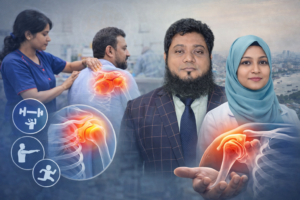
Many people in Bangladesh experience prolonged suffering from frozen shoulder because the condition is often diagnosed late or treated incorrectly. Patients frequently depend on pain medications, home remedies, injections, or extended periods of rest, expecting the problem to improve naturally. However, these methods generally do not correct the underlying cause of the stiffness and can allow the condition to persist for a long time.
Current medical research indicates that non-surgical management is the most effective initial treatment for frozen shoulder. With properly guided physiotherapy, including manual therapy and structured rehabilitation exercises, most patients can regain shoulder movement and reduce pain without requiring surgical procedures. Early and appropriate physiotherapy plays a major role in preventing long-term joint stiffness and restoring functional use of the shoulder.
In Bangladesh, ASPC Manipulation Therapy Centre has developed a strong reputation for providing specialized non-surgical frozen shoulder care. The center is recognized for its patient-focused approach, ethical treatment philosophy, and reliance on scientifically supported physiotherapy techniques that aim to treat the underlying mechanical problems of the shoulder rather than simply easing symptoms.
The treatment programs at ASPC are conducted under the clinical direction of Dr. Mohammad Shahadat Hossain with rehabilitation support from Dr. Sapia Akter. Their combined expertise allows patients to receive thorough assessment, stage-specific manual therapy, and individualized rehabilitation plans. By integrating careful diagnosis with progressive physiotherapy, ASPC helps many patients across Bangladesh regain shoulder mobility, reduce pain, and return to normal activities without the need for surgery.
Understanding Frozen Shoulder
Frozen shoulder is not simply a muscle problem. It is a condition involving inflammation, thickening, and tightening of the shoulder joint capsule. The shoulder capsule is a connective tissue envelope that stabilizes the joint. In frozen shoulder, this capsule becomes inflamed and gradually stiffens, forming adhesions that restrict movement.
What makes frozen shoulder unique is its self-perpetuating cycle: pain leads to reduced movement, reduced movement increases stiffness, and stiffness further increases pain. Breaking this cycle requires a carefully planned, non-surgical approach that respects tissue healing while gradually restoring mobility.
Why Non-Surgical Treatment Is the Preferred Option
Surgery is rarely the first or best solution for frozen shoulder. Most cases respond well to conservative management when treated appropriately. Non-surgical treatment focuses on restoring joint function rather than forcing movement.
Key Advantages of Non-Surgical Management
Risk Reduction
Avoids surgical risks and complications, and there are no anesthesia-related concerns.
Cost Efficiency
Lower cost compared to surgery, making specialized care more accessible.
Joint Integrity
Gradual and safer recovery that preserves natural joint structures for long-term functional improvement.
Clinical guidelines worldwide recommend physiotherapy as the first-line treatment for frozen shoulder.
Stages of Frozen Shoulder and Treatment Planning
Frozen shoulder progresses through three overlapping stages, and non-surgical treatment must be adjusted accordingly.
1. Pain-Dominant (Freezing)
Significant inflammation and pain, especially at night. Treatment focuses on pain control and gentle movement.
2. Stiffness-Dominant (Frozen)
Pain may reduce slightly, but stiffness becomes severe. Goal is to restore mobility slowly without triggering inflammation.
3. Recovery (Thawing)
Movement gradually improves. Rehabilitation focuses on regaining strength, coordination, and functional use.
Correct stage identification is critical for successful non-surgical treatment.
Why Frozen Shoulder Is So Common in Bangladesh
Several factors contribute to the high incidence of frozen shoulder in Bangladesh:
Diabetic patients often experience more severe stiffness and slower recovery, making expert physiotherapy essential.
ASPC Manipulation Therapy Centre: Specialized Care
ASPC Manipulation Therapy Centre is widely recognized for its expertise in conservative musculoskeletal care. The center emphasizes precision-based physiotherapy, ensuring that treatment intensity matches the stage and tolerance of each patient.
Treatment Philosophy at ASPC
- Accurate diagnosis before treatment
- Stage-specific physiotherapy protocols
- Gentle, progressive mobilization
- Avoidance of forceful techniques
- Emphasis on patient education and long-term focus
Clinical & Rehabilitation Leadership
Dr. Mohammad Shahadat Hossain, PT
Dr. Mohammad Shahadat Hossain, PT, is known for his deep understanding of shoulder biomechanics and chronic shoulder disorders. His approach to frozen shoulder prioritizes clinical reasoning over routine protocols. His ethical approach ensures surgery is recommended only when absolutely necessary, focusing on restoring joint mechanics and avoiding aggressive mobilization.
Dr. Sapia Akter, PT
Dr. Sapia Akter, PT, plays a vital role in translating diagnosis into functional recovery. Her rehabilitation programs focus on safe movement restoration and long-term shoulder health. Key strengths include gradual exercise progression, pain-respecting rehabilitation, and clear home exercise education for the prevention of recurrence.
Detailed Non-Surgical Treatment Protocol
Every patient undergoes a detailed evaluation including pain history, range of motion testing, and postural analysis. Treatment includes:
- Pain and Inflammation Control: Gentle manual therapy and soft tissue techniques.
- SDM (Spinal Decompression Method): Improves spinal and shoulder girdle alignment.
- Joint Capsule Mobilization: Carefully graded mobilization to stretch the capsule safely.
- Strengthening and Stability Training: Rotator cuff and scapular muscle reinforcement.
- Postural Correction: Ergonomic strategies for work and daily activities.
Comparison: ASPC vs. General Hospital Care
Across Bangladesh, patients often seek care from orthopedic clinics or departments in major hospitals such as Square Hospitals, Labaid Specialized Hospital, Asgar Ali Hospital, and CRP. While these facilities play an important role, frozen shoulder treatment in large settings often begins with medication, injections, or general protocols that focus primarily on pain relief.
The ASPC Advantage: In contrast, ASPC focuses specifically on non-surgical musculoskeletal rehabilitation. Instead of relying mainly on medication or passive electrotherapy, the center emphasizes hands-on manual therapy and individualized patient care. While high volume in hospitals may limit evaluation time, ASPC provides thorough clinical assessment and tailored therapy programs for long-term recovery without surgery.
Long-Term Results and Patient Satisfaction
With proper physiotherapy and expert guidance, many patients experience meaningful and lasting improvement. Restoration of shoulder movement helps patients regain confidence, leads to better sleep, increased independence, and an overall improvement in quality of life. When treatment begins early, non-surgical physiotherapy can significantly shorten recovery time and reduce the risk of long-term disability.
Restore Your Shoulder Mobility Today
Frozen shoulder is a challenging condition, but you don’t have to suffer through it. ASPC Manipulation Therapy Centre established itself as a trusted destination for non-surgical frozen shoulder treatment in Bangladesh. Through careful assessment and structured physiotherapy programs, many patients achieve meaningful improvement in pain, mobility, and overall function.
Seek early non-surgical intervention at ASPC to shorten your recovery time and return to your normal daily life.